
Indianapolis Directory Runs and Access
The Indianapolis City Directory digital collection brings together every published Indianapolis directory dated from 1855 through 2001. IU Indianapolis University Library, Indianapolis Public Library, and the Indiana State Library created the collection. Large books may be split into parts, so a search must cover all parts for a year. The date range describes the collected publication sequence, not a promise that one uniform city volume appeared every year.
| Collection | Years | Where held | Access |
|---|---|---|---|
| Indianapolis city directories | From 1855; city print run ends 1989 | IU Indianapolis, IndyPL, State Library partners | Digital collection; print and microfilm routes vary |
| Suburban directories | Added 1957; end 1991 | IndyPL and partner holdings | Ask for the place and year |
| Marion County Directory | 2001 | Partner digital collection | Browse by volume and part |
| Selected Indianapolis volumes | 1890; 1929, 1930, 1931 examples | Indiana State Library and NARA references | Reference desk, catalog, or listed repository |
| Mid-19th-century directories | Varies by title | Indiana Historical Society | Reference Room and finding aids |
IndyPL's chronology says the printed Indianapolis directory ceased in 1989, suburban publication continued to 1991, and a Marion County directory appeared in 2001. That sequence explains why a late search may require a suburban or county title instead of the old city series.
The collection overview is the most direct door to the full Indianapolis city directory run.
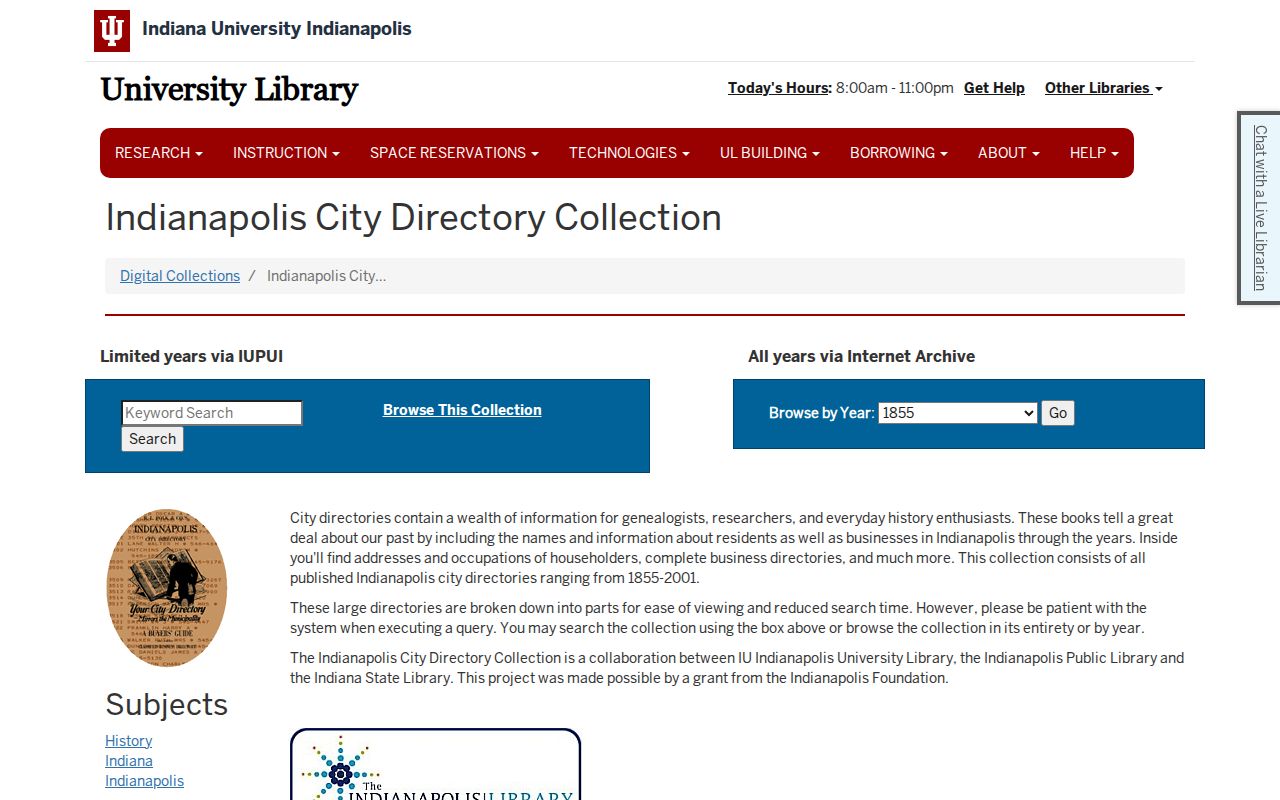
The overview helps choose a year before moving into page-level search and image review.
Indianapolis City Directory Timeline
The publication history changes what can be found and how. Record the type of volume as well as the year. A city book, suburban book, and county directory may cover different communities even when all are grouped in one digital collection.
| Year | Directory milestone |
|---|---|
| 1855 | The Indianapolis directory sequence begins. |
| 1957 | Suburban directories are added to the local chronology. |
| 1960 | An R. L. Polk volume survives digitally in split parts; Part 1 covers A through D. |
| 1989 | The printed Indianapolis city series ceases. |
| 1991 | The suburban directory series ceases. |
| 2001 | A Marion County Directory appears. |
Address changes in 1887, 1899, and 1916 form another timeline beneath the publication sequence. A family may stay put while its printed number changes. Compare the street guide and a period map before treating that change as a move.
Note: Available years and neighborhood coverage vary, so a blank year should be reported as a gap rather than proof of absence.
Search Digitized Indianapolis Directories
The ContentDM directory search provides digitized pages and item metadata. Browse by year first, then search several forms of a surname, initials, street name, and number. Large volumes may be divided. A hit can land on a resident page, street guide, business list, or classified page, and those page types do not mean the same thing.
Optical character recognition, called OCR, converts a page image to searchable text. It is useful for discovery but can mistake old type, initials, punctuation, abbreviations, and street numbers. Always compare the text hit with the scan. Keep the parent volume, child page, page number, and image URL so another researcher can repeat the reading.
The digitized collection search screen shows the current browse and query route.
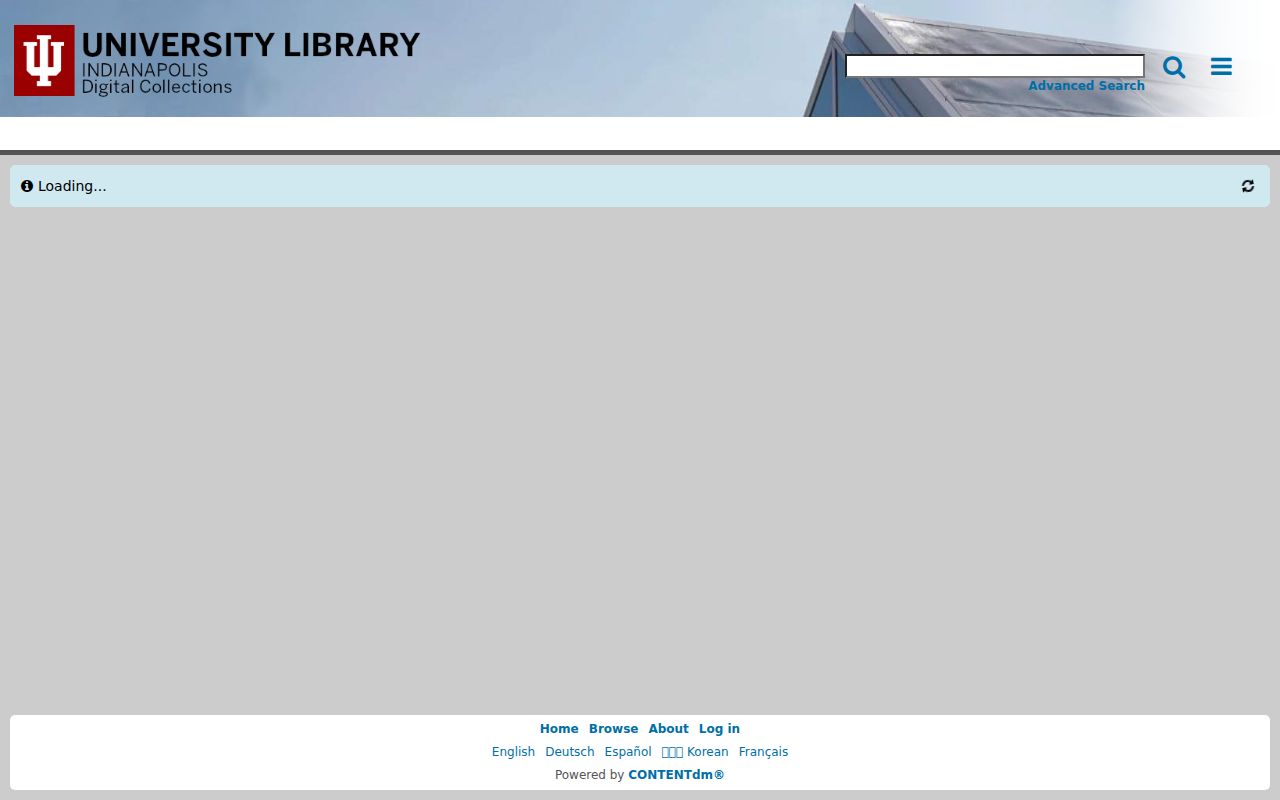
Use search to locate a candidate, then cite the scan rather than uncorrected OCR.
Decode an Indianapolis Directory Entry
A typical Indianapolis city directory entry can combine a printed name, initials, an address, occupation or status shorthand, spouse or widow notation, and sometimes telephone or business information. It is a publisher's compiled entry, not a sworn statement. Read the abbreviation key from that volume because meanings and layout can change by publisher and year.
| Printed name | Copy surname, given name, and initials exactly before testing alternate spellings. |
|---|---|
| Address | Keep the number and street as printed; do not silently modernize it. |
| Household notation | Spouse, widow, or status words can connect relatives but still need another record. |
| Occupation or firm | Provides period context; it does not itself establish the home address unless the entry prints one. |
| Section and page | Distinguishes a resident entry from a street, business, or classified listing. |
- Criss-cross directory
- A directory or section arranged by street and house number, useful when the address is known but the name is not.
- Householder index
- An address-oriented list of the person identified by the publisher as the principal householder.
- Abbreviation key
- The volume's own legend for shortened words and symbols. Photograph or save it before expanding an entry.
- OCR
- Machine-read text made from a scan. It is a finding aid and must be checked against the image.
Pre-1914 directories may give only surnames and omit streets. Some areas were not covered in early books. A no-hit has to remain uncertain unless other sources show the person elsewhere.
Inside Indianapolis Polk in 1960
The 1960 sample gives a concrete way to understand the collection. Its parent metadata identifies “Indianapolis City Directory for 1960, Part 1 (covers A-D),” created by R. L. Polk & Co. The part contains 515 pages, is owned by the Indiana State Library, and was digitally published by IU Indianapolis University Library in 2006. Child pointers lead to individual scans.
The 1960 volume metadata shows why part and page identifiers belong in every citation.
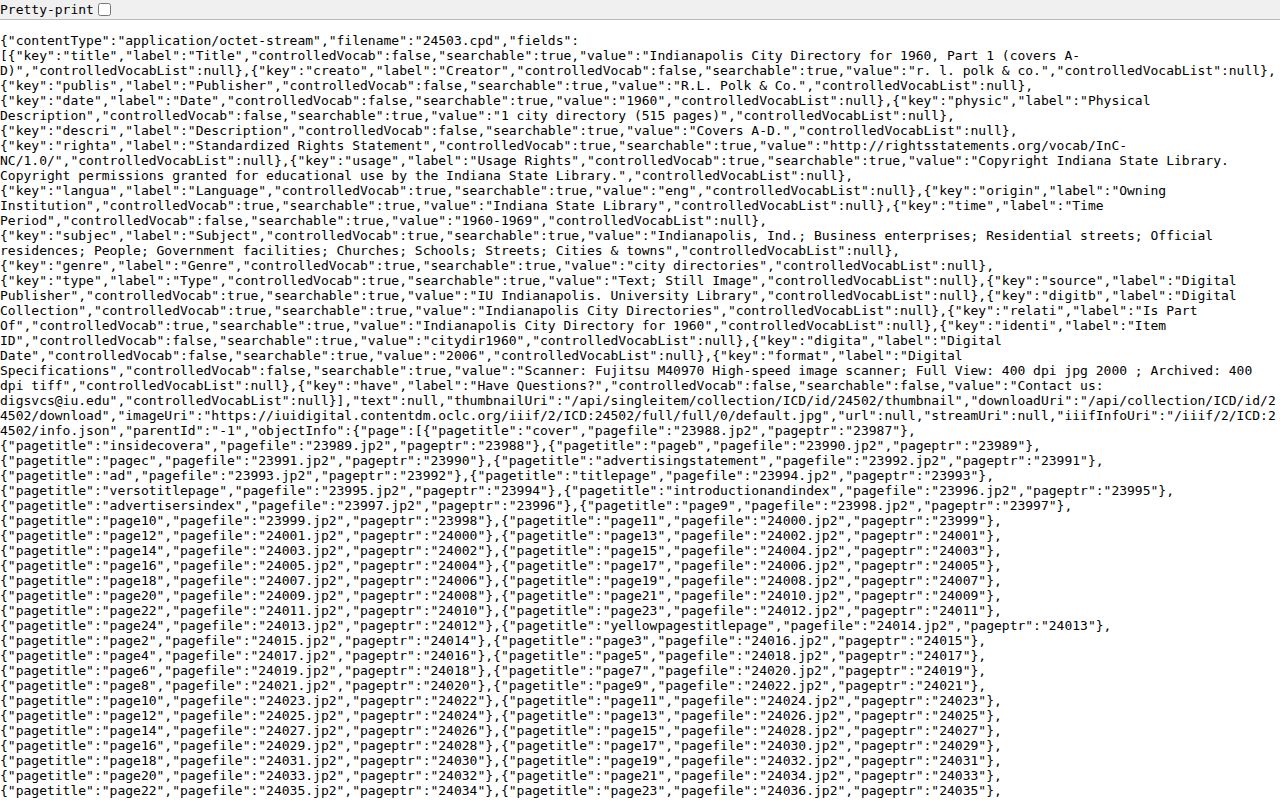
The record prevents a page from being mistaken for a complete unsplit 1960 volume.
A separate 1960 child-page record ties one scan to that parent.
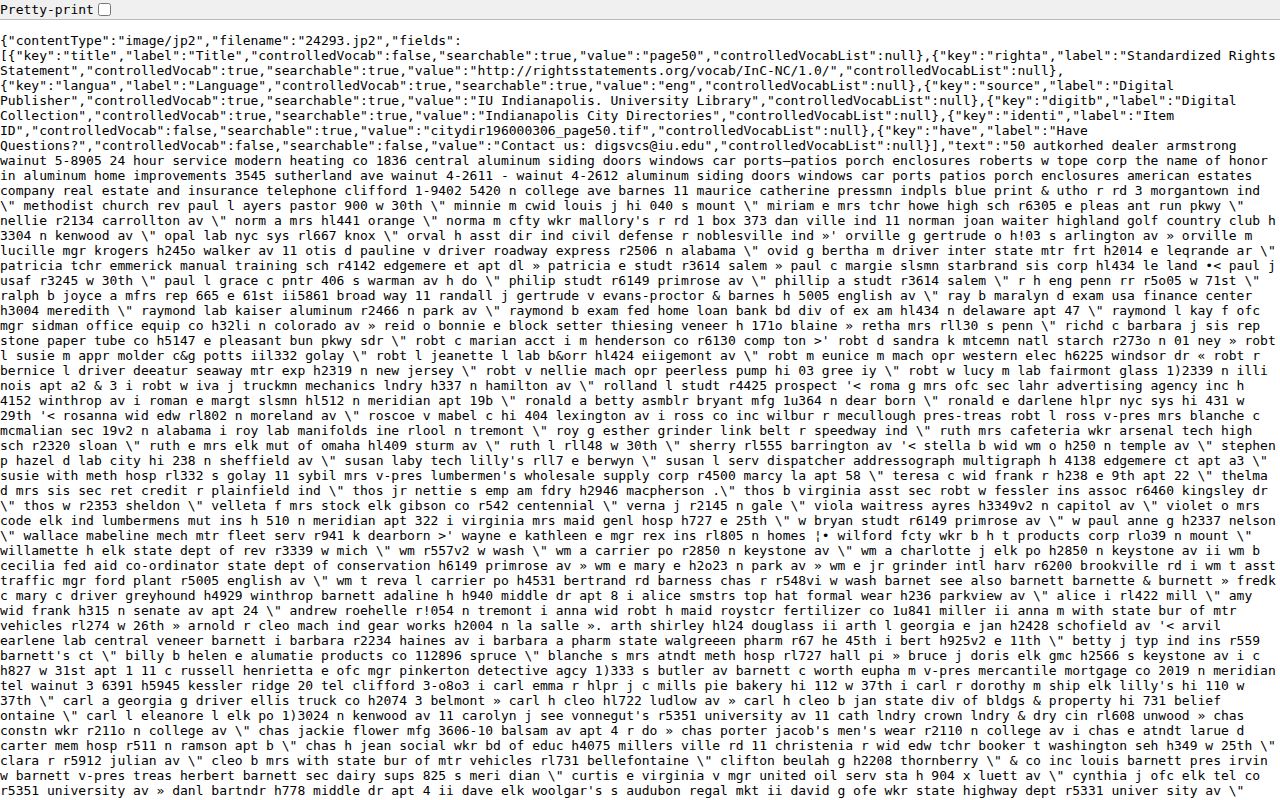
Child metadata supplies the page-level trail needed to review OCR and section type.
The corresponding directory page image displays the printed entries themselves.

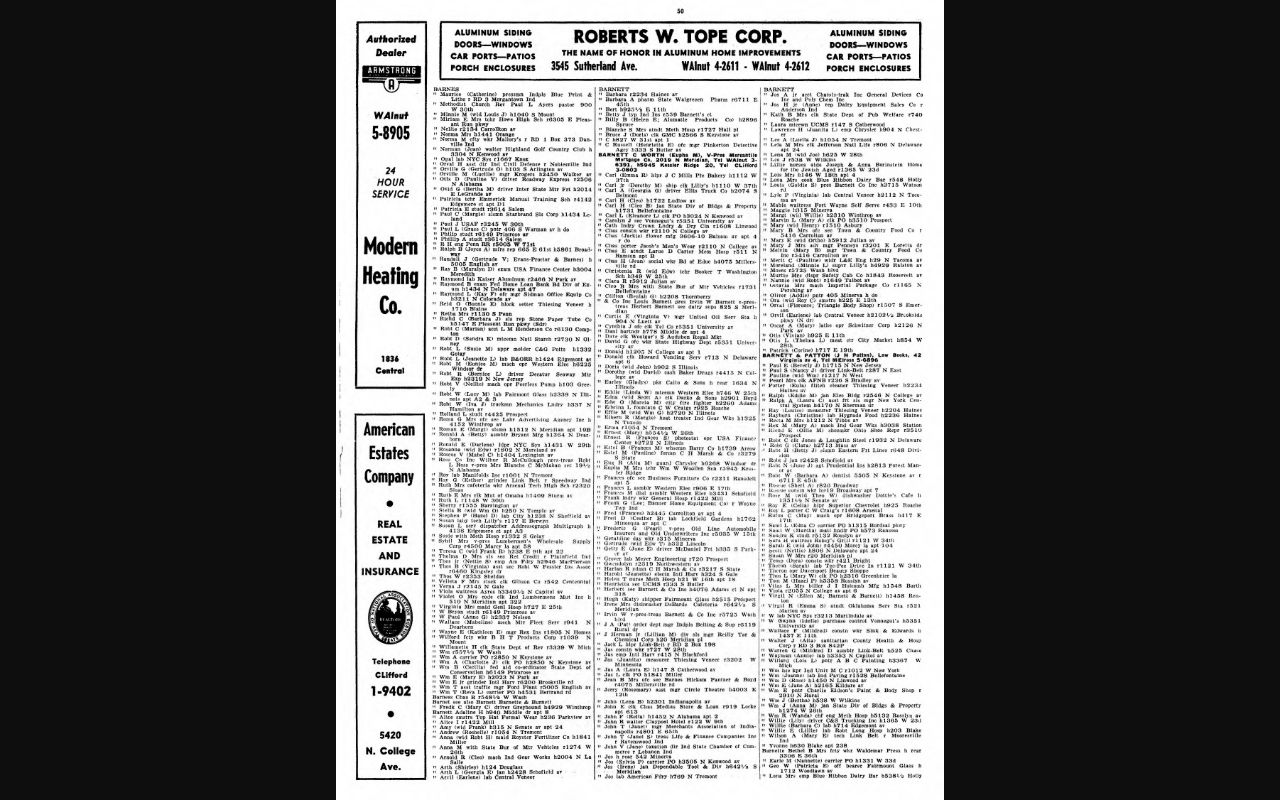
Read short forms such as h, r, wid, and mrs against the volume key, and check every OCR transcription on this image.
Find Indianapolis Directory Help
Indianapolis Public Library Central Special Collections, at 40 E St Clair Street, is the practical first stop for directories, local newspapers, clipping files, photographs, scrapbooks, census and genealogy databases, yearbooks, and house-history help. Some databases work only inside the library. Ask for a year, title, street, and surname rather than a broad search for everything about one family.
The IndyPL genealogy collection connects directories to newspapers, census tools, Digital Indy, and school sources.
The library route matters when a scan is missing, OCR fails, or a source is licensed for in-library use.
Indiana Historical Society adds mid-nineteenth-century directories, photos, manuscripts, newspapers, and house histories. Its Reference Room is at 450 W Ohio Street, 317-232-1882, generally Tuesday through Saturday from 10 to 5; some holdings require an appointment. The Indiana State Library provides the Marion County guide, city-directory call numbers, Indiana Legacy indexes, and reference help. The State Archives holds government, land, and court series at 6440 E 30th Street and encourages appointments.
Gaps in Indianapolis City Directories
The Indianapolis collection is broad, but publication is not full population coverage. Early books can be poorly organized, use inconsistent spellings, or omit a developing area. The local house-history sample for 6017 Indianola Avenue traces residents from 1918 to 1952, yet it notes that directories before 1923 did not cover Indianola Avenue in the same useful fashion. Pre-1914 entries may be surname-only and lack a street.
Street pages can act as a reverse-directory substitute where no distinct reverse title is verified. Ask IndyPL, IHS, or the State Library for the street or address section and microfilm for the year. Do not promise a complete current criss-cross product. For a missing name, test initials, spouse name, alternate spelling, nearby years, and the image itself.
Insider tip. Save the abbreviation key and street guide with the entry; both can resolve a false move or a bad OCR reading.
Trace Family Through Indianapolis Directories
Directories work best as an annual or near-annual bridge between census years. Begin with one confirmed year, then move one volume at a time. Record exactly what changes and what stays the same. A missing entry can mean death, a move, omission, a spelling change, or a publication gap.
- Find the surname in a known Indianapolis directory year, and confirm the page image, section, address, and short forms.
- Search the prior and next available years. Note address, spouse notation, occupation, and any switch in printed initials.
- Check the street section for other names printed at the same number, without assuming they form one family.
- Pair the trail with released federal census schedules from 1850 through 1950. Remember that most of the 1890 census was lost.
- Use a dated newspaper, obituary, probate index, school source, or cemetery record to explain an appearance or disappearance.
Indiana Legacy can add birth, death, obituary, marriage, divorce, cemetery, newspaper, and school indexes. The Marion County divorce index covers 1912 through 1935. Crown Hill research can add burial and funeral evidence; FamilySearch lists Crown Hill Funeral Home Records from 1834 through 1959. Each source has its own access and proof limits.
If the question becomes a modern parcel and its current public records, follow the Indianapolis by-street record chain rather than projecting a historic directory entry into the present.
Test Indianapolis Entries With Context
Baist and Sanborn maps describe lots, blocks, building footprints, materials, and changes to the physical site. They are evidence about the house, not a household roster. Use them to bridge old and new numbers or to test whether a building existed in the directory year. Current GIS neighborhood names should not be applied to a historical address without support from a period source.
Newspapers and obituaries can add dates, relatives, events, and address context. IndyPL points to Indianapolis Star holdings, Hoosier State Chronicles, Newspapers.com, Digital Indy, clipping files, and Central Library microfilm. IHS photographs and organization papers can place the street in a richer setting. Cite the publication, date, page, and image. A similar name without a matching date or address is only a candidate.
Note: A city directory marks a published association with an address; another dated source is needed before making a firm identity claim.