
Find Indianapolis Residents Carefully
Choose the first record by the fact already known. An address belongs in the Marion County Assessor search. A known owner or deed party belongs in the Recorder index. A case number or party name belongs in Indiana MyCase. Older names and addresses belong in the Indianapolis city directory collection. These sources are not interchangeable. The assessor identifies an owner of record, while a directory can identify a person printed at an address in a certain edition.
Official indexes are strongest when two records agree on a date, place, or role. They still do not form a complete roll of every Indianapolis household. Renters, children, unregistered voters, people using protected addresses, and residents omitted from an old directory may leave no open entry. Keep each claim narrow and date it.
- Search the Assessor Property Cards by address or owner name and save the parcel number, situs, and mailing fields.
- Check the Recorder Direct Search for recorded parties, dates, legal descriptions, and prior deed references.
- Use MyCase or the marriage lookup only when a court or marriage record fits the question.
- For an older household, compare several directory years with census, newspaper, and map evidence.
- If the record is not online, ask its custodian for one defined record or date range under APRA.
Indianapolis Directory Record Keepers
Most Indianapolis residents directory work crosses city, county, and state custody. The consolidated city-county government makes Marion County offices central, but the record itself still decides the keeper. The Recorder holds recorded land documents. The Assessor publishes property cards. The Clerk keeps court and marriage records, while the state judiciary publishes the public MyCase index. Election and vital records follow separate state and local rules.
Marion County Recorder
200 E Washington St, Room 741
Indianapolis, IN 46204
317-327-4020
Marion County Health Department
3838 N Rural St
Indianapolis, IN 46205
317-221-2000
Search Indianapolis Property Cards
The Assessor Property Cards portal is the fastest official bridge from a street address to a parcel. It accepts a seven-digit county parcel number, an eighteen-digit state parcel number, part or all of an owner name, or an address chosen from suggestions. A card can show the owner as recorded, a mailing address, property situs, township, tax district, neighborhood, legal description, transfer details, land data, and assessed values.
Read the labels before drawing a conclusion. The situs is the place of the parcel. The mailing address is where the tax notice goes. They may differ, and neither field alone proves who sleeps at the property. One official sample in the research has a Shelbyville mailing address and an Indianapolis situs, a useful warning against turning an owner or mailing record into an unsupported residency claim.
| Search choice | Input | Best use |
|---|---|---|
| County parcel | 7-digit number | Open one known Marion parcel |
| State parcel | 18-digit number | Match a statewide parcel reference |
| Owner | Full or partial name | Find property tied to a recorded owner |
| Address | Suggested street address | Move from a place to its property card |
The official Indianapolis GIS hub links the assessor and map tools used for this check.

The hub separates parcel, neighborhood, organization, and other map applications, which helps keep an address search tied to the right kind of evidence.
Current Indianapolis Directory Sources
No current source names every person in Indianapolis. Each roll lists people because of a specific public activity, such as owning land, recording a deed, registering to vote, appearing in a public court matter, holding a professional license, or acting for a business. That purpose controls what the index means and what details may be withheld.
| Official source | What a name means | Keeper | Access |
|---|---|---|---|
| Property card | Owner of record for a parcel | Marion County Assessor | Free portal |
| Recorded-document index | Party to a deed, mortgage, lien, or other instrument | Marion County Recorder | Free index |
| MyCase | Party or attorney in a public case | Indiana courts and county Clerk | Public index |
| Voter services and files | Registration or election record subject to state limits | Election officials | Service portal or formal file route |
| License verification | Credential holder by profession and place fields | Indiana PLA | Free verification |
Use the record date and role, then look for a second source. A deed party may be an estate or company. A court party may have only filed in Marion County. A voter status portal serves the voter and is not a casual name-by-address roll.
Indianapolis Deeds Begin in 1821
The Marion County Recorder traces real-estate and related recorded documents back to 1821. Direct Search supports party, document, file, book and page, parcel, and legal-description paths. A grantor is the party giving an interest. A grantee receives it. Those labels make the index valuable for estates and house history, but they show a recorded transaction rather than everyday occupancy.
Format changes matter. Records from 1821 through 1949 use older book, page, and book-type conventions. The official guide directs researchers to an A-style instrument number for 1950 through March 31, 1964. Later searches may use an instrument number. Online index and image coverage are not identical, so an office request or public terminal remains part of the fallback.
- Index
- A finding list that points to a record; it is not always the full document image.
- Parcel
- A mapped unit of land identified by county and state numbers.
- Legal description
- The recorded words that identify land, often by lot, subdivision, or survey.
- Criss-cross directory
- A directory organized by street or address instead of only by surname.
Verify Indianapolis Court Names
Indiana MyCase searches nonconfidential public case information by case, party, attorney, court, case type, status, and filing-date range. A party search starts with a last name or business name and can narrow by first or middle name and date of birth. Sounds-like and trailing wildcard options help with spelling. Public results are capped, CAPTCHA can appear, and the date of birth used to narrow a search is not displayed as a normal result field.
A result needs context. Record the case number, court, filing date, party role, status, and document availability. Older cases may be missing from online coverage, while adoption, juvenile, sealed, and other protected material is restricted. The Marion County Clerk is the route for offline or certified court records. Marriage License Public Lookup covers many, not all, records from 1993 forward, and the county that issued a license does not by itself establish residence.
The official MyCase public search shows the statewide entry point used for Indianapolis court leads.
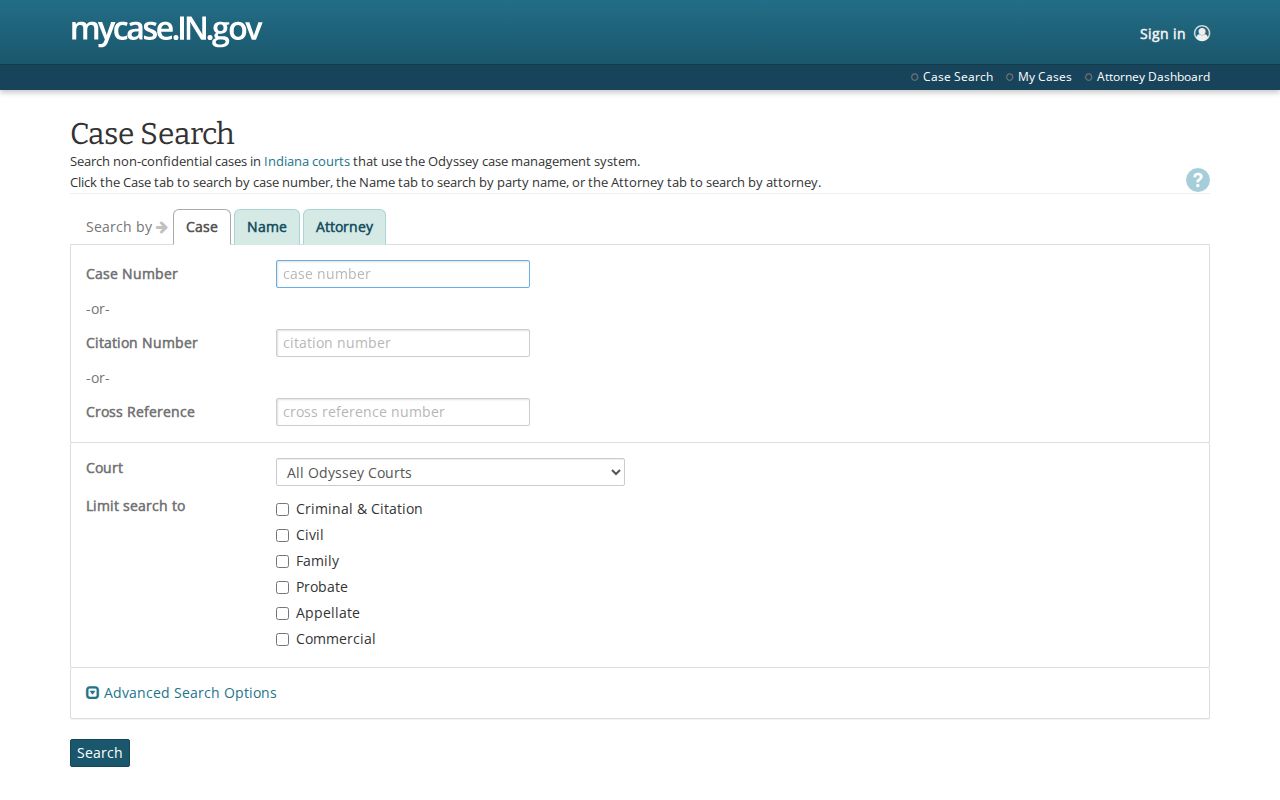
The portal supplies a case lead; the Clerk remains the keeper for local copies and older material.
Browse Indianapolis City Directories
The digitized Indianapolis city directory collection brings together all published directories dated from 1855 through 2001 through IU Indianapolis University Library, Indianapolis Public Library, and the Indiana State Library. The printed Indianapolis run ended in 1989, suburban directories continued through 1991, and a Marion County directory appeared in 2001. Large volumes may be split into parts.
An entry may show a name or initials, address, spouse or widow notation, occupation, phone number, or business tie. It is historical publication evidence, not a sworn address record. Pre-1914 editions may be surname-only and omit a street. Early coverage also missed some areas. OCR helps locate a page but can misread punctuation and names, so verify the page image. The complete reading and year-by-year method belongs in the Indianapolis city directory collections.
Old Indianapolis Addresses Shift
Indianapolis address changes in 1887, 1899, and 1916 can hide a household from an exact modern-address search. Keep the old printed number beside the current assessor situs rather than silently replacing one with the other. Directory street pages, the Indianapolis Public Library house-history guide, Baist atlases, and Sanborn maps can bridge the two.
Maps prove the lot, building form, or number used at a time. They do not list a whole household. Sanborn coverage for Indianapolis spans 1887 through 1950, while the researched Baist editions include 1901, 1908, 1909, 1916, 1927, and 1941. Pair that physical evidence with a directory, census, deed, obituary, or newspaper before naming a resident.
Indianapolis Vital Record Limits
Indiana state birth records begin in October 1907 and death records in 1900. The Indiana Department of Health and Marion County local health channel handle certificates under direct-interest and identity rules. Current genealogy access for a nonfamily requester can apply when the event is more than 75 years old and the person is deceased, subject to proof. A certificate connects a person to an event and date, not to a current home.
Marriage and divorce certified copies come from the county Clerk. Indexes such as Indiana Legacy, FamilySearch, newspapers, cemetery material, and the public marriage lookup can provide leads, but an index is not a certified copy. The local health office can explain whether an older record is held locally and what proof is needed. Do not send identity documents to an address copied from an unofficial listing.
Indianapolis ZIPs Need Two Checks
Indianapolis GIS publishes ZIP polygons, neighborhoods, town boundaries, and excluded-city layers. USPS controls the mailing result. Those systems answer different questions. A parcel can sit in Marion County, use an Indianapolis mailing label, and still relate to an excluded municipality such as Beech Grove, Lawrence, Speedway, or Southport.
Enter the full street and unit in USPS By Address, then compare the returned city and ZIP with MapIndy, the assessor situs, and the city or town layer. Edge values in the local GIS include 46077, 46107, 46113, and 46183 as well as many 462xx polygons. A ZIP result does not confirm that a person or company occupies an address. It only helps normalize mail geography.
Request Indianapolis Records Narrowly
The Indiana Access to Public Records Act, IC 5-14-3, supplies a route when an existing city or county record is not posted. Direct the request to the office that keeps the record. Describe the record type, address or party, date range, and preferred format. Ask for an existing index, instrument, permit case, or file, not for the agency to create a new resident profile.
Changes under HEA 1360 took effect July 1, 2026. The Public Access Counselor explains new electronic portals, CAPTCHA, address and residency checks, request priority, supplemental actual-cost fees, and safeguards against scraping or cybersecurity risk. A clear manual request with a personal, civic, academic, or journalistic purpose is more useful than a broad demand. Keep the acknowledgment, and ask the Public Access Counselor about the process if an agency denies access.
Protect Indianapolis Confidential Addresses
Indiana's Address Confidentiality Program, also known as Safe at Home, shields address information for eligible participants. Voter confidentiality provisions and separate property-database restrictions for certain protected public officials mean an ordinary public search may correctly omit a record. Do not try to reconstruct a protected address from other rolls.
Use official resident rolls with less detail than a commercial people-finder category often promises. Official sources name the keeper, record purpose, date, and access rule. A broad commercial compilation may merge old addresses and unrelated names without showing those distinctions. Verification belongs with the custodian.
| Source type | Strength | Limit |
|---|---|---|
| Official roll or index | Named custodian and defined public purpose | May exclude private or protected fields |
| Historical directory image | Dated printed entry that can be checked | May be stale, omitted, or misread by OCR |
| Commercial compilation | Broad discovery category | Source dates and identity links may be unclear |
Recorder Alerts Reach Indianapolis Owners
The Marion County Recorder promotes a property-fraud alert that can notify a registrant when a document is recorded under a watched name. It does not block a filing or decide whether the document is valid. The alert is a prompt to inspect the official record and contact the Recorder through a verified channel.
A July 2026 Recorder report recorded 11,084 documents, including 9,633 electronic recordings, and reported 1,115 new alert signups. Those figures show why a name alert can be useful, but they do not turn the service into an ownership guarantee. The property fraud alert service is the official route linked in the manifest.
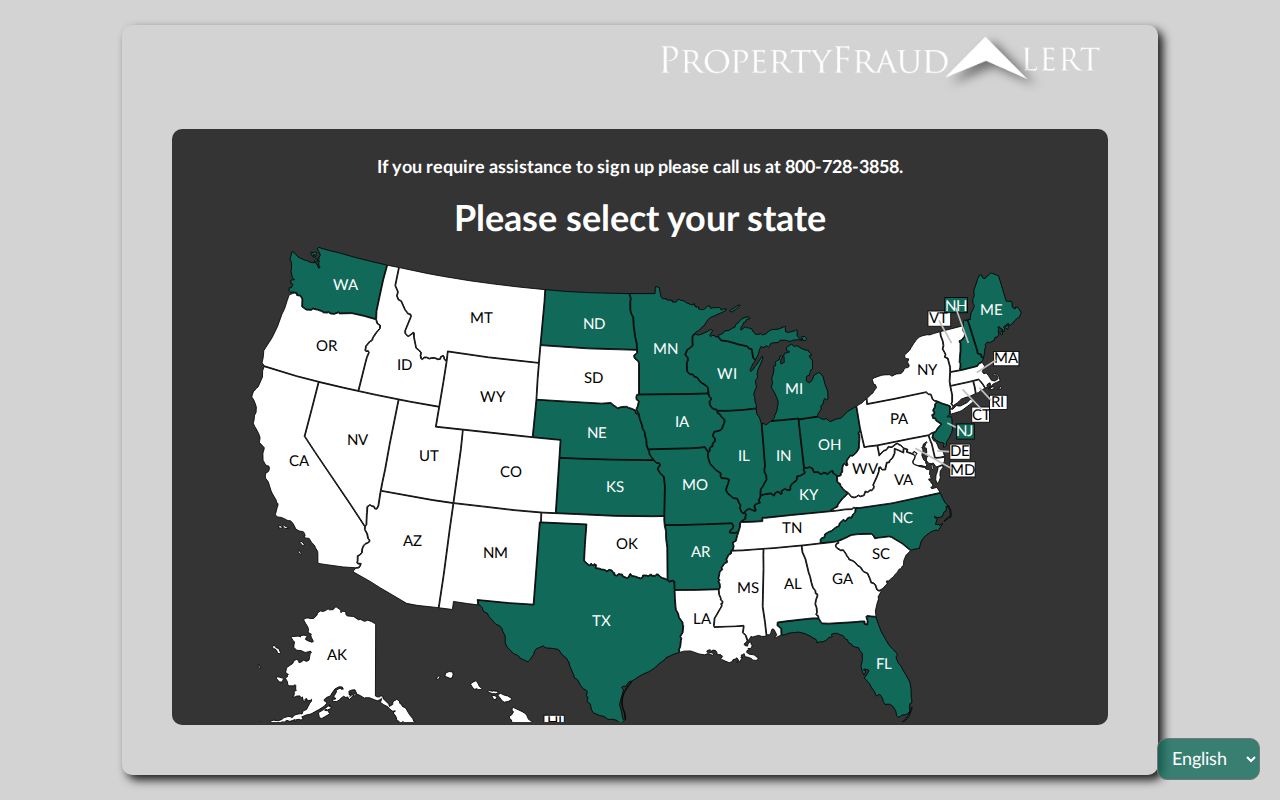
The alert supports fast review of a new filing while the Recorder's index and document remain the evidence to inspect.